
Breaking Down a Commanders Play Call from Rookie Minicamp
Looking at the details and potential terminology of a play called during Commanders rookie minicamp

The Washington Commanders held their first rookie minicamp over the weekend and on Friday of last week we got to see footage of the Commanders draft class practicing with their new teammates and coaching staff. These practices are used just to onboard the rookies into the system, teaching them not only the playbook, but also things like where different meeting rooms are in the building, what time they need to be in the weight room, what time they need to be down on the field etc.
With that in mind, it’s important not to get carried away with any clips or highlights you might have seen on social media from those rookie minicamp practices. However, there were a few interesting clips that did the rounds online which I thought could be interesting to talk about. Later in the week I’ll break down a clip that gives us a preview/confirmation of a Commanders defensive scheme, but today I want to focus on the offense and one clip in particular.
This clip comes from Scott Abraham of 7 News DC. He posted the clip to show seventh round quarterback Athan Kaliakmanis in action for a couple of plays, but I’ve cut the clip down to just the second play.
What you’ll see here is Kaliakmanis getting a playcall from offensive coordinator David Blough into his helmet and then having to go into the huddle and relay that call. You can see he has a bit of trouble with it, which is normal for a first practice session for a young quarterback. It’s all new terminology and it’s easy to get things mixed up. I’m sure Jayden Daniels will have some moments like this too.
You can see the typical struggles for an early rookie mini camp here. Kaliakmanis steps into the huddle and then steps back out to get the play called to him again. Then the team breaks the huddle and a tight end lines up in the wrong spot. Kaliakmanis looks to correct him but a coach steps in and they reset back to the huddle. Kaliakmanis gets the call again, relays it to the huddle and this time they get lined up properly and run the play.
To give an insight as to why those struggles happen early on, I thought I’d break down what a play like this might be called and show what the individual parts of the call might mean. Now I must point out that I don’t know what terminology David Blough is using. He’s been in a lot of different systems, but most commonly been in some form of a west coast offense. West coast offenses are so widely spread around the league that terminology within them can vary quite a lot, but the one I’m most familiar with is the Kyle Shanahan system, so I’ll use that terminology to break down this play, as well as some pictures from a Shanahan playbook.
In the Shanahan system, this particular play would be called something like “West Right Slot F Left 19 Wanda F Sift”. That sounds like a bit of a mouthful, but it’s simple when broken down. West coast offense play calls all follow the same structure:
1. Shift
2. Formation
3. Formation variation
4. Motion
5. Run target/pass protection
6. Run/pass concept
7. Snap count
So if we apply that to our play call, we can get a better idea of what the play actually is. There’s no shift on this play, so we can skip the shift and start with the formation. The basic formation in our call here is “West Right”. To understand West Right, we need to see a more basic formation first.
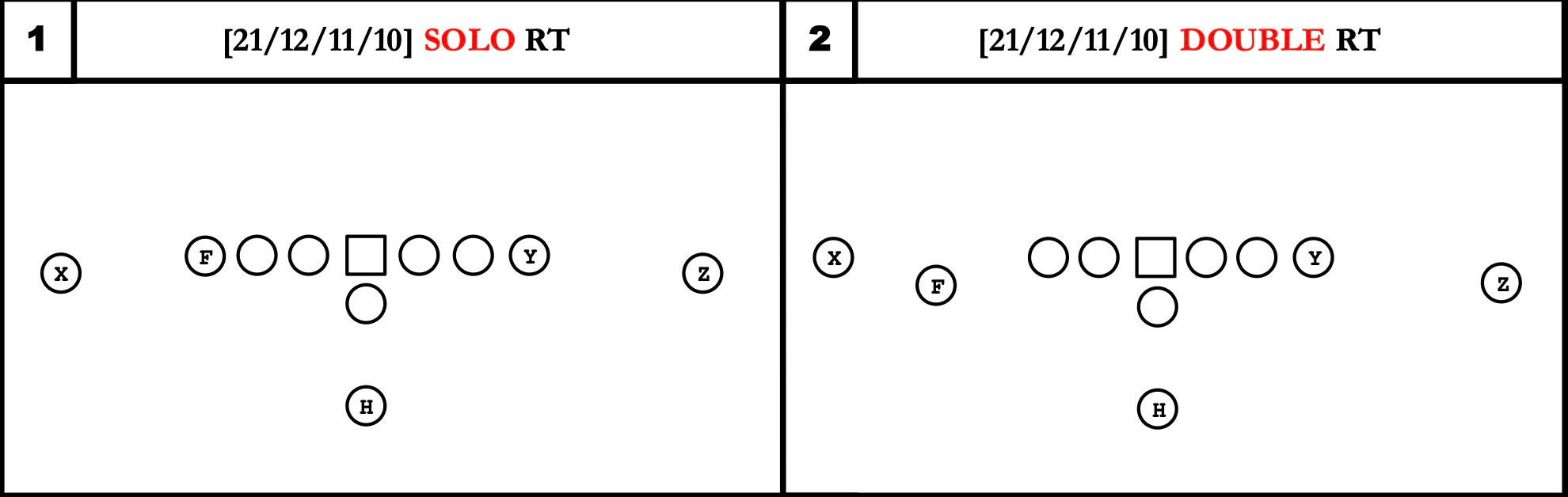
This picture shows two basic formations that every team in the NFL uses. Each time might have a different name for them, but most west coast offenses use these terms. Solo Right is a basic two by two formation. You’ll notice numbers before the name of the formation, those are personnel groupings. The first digit refers to the number of running backs (including fullbacks) while the second number refers to the number of tight ends. So in 21 personnel, there’s two running backs and one tight end. In 12 personnel, there’s one running back and two tight ends.
The play we saw from the Commanders had two tight ends on the field, so we’ll stick with 12 personnel for now, but when you’re looking at these diagrams, it’s important to know the positions. The X and Z are outside receivers. The X receiver is typically the guy you will isolate to one side of the field and trust to win one-on-one matchups, think Terry McLaurin. The Z receiver can play a variety of roles in different offenses. Sometimes it’s just another outside receiver, sometimes the Z receiver can be moved all over the field and sometimes it’s a speedy deep threat.
The Y is the primary tight end. It’s important to know who that guy is because the formations are set to that player. When you hear a direction call like right or left, that tells the Y tight end which side of the field to line up on, and then the rest of the formation is set up from there. So in all of our examples, the formation is called to the right, which puts the Y tight end to the right of the formation. The Z receiver typically aligns to the Y tight end’s side of the field while the X receiver typically lines up on the opposite side, as you can see in both of these formations.
The F is known as the adjuster. In 21 personnel, the F is the fullback, but in 12 personnel, the fullback is substituted for a second tight end. In 11 personnel, the F becomes a slot receiver. In old west coast offenses, these personnel groups had different names, so the F would get different terms too. If you look at old Mike Shanahan playbooks, for example, you’ll see terms like Tiger and Zebra. Tiger was used as a code word for 12 personnel and on those plays, the F would be changed to a U. Zebra was code for 11 personnel and the F would change to a Ze in those plays. But the modern coaches have seen that as an old, outdated system and just use the numbers to designate the personnel groups and have the F be known as the adjuster.
So now if we get to these formations, we see Solo Right is a two by two formation with a receiver and tight end on either side of the formation. The Y and Z are to the right while the F and X are to the left. In Solo Right, both tight ends are attached to the formation, so they both line up on the line of scrimmage, which means both receivers can take a step back off the line of scrimmage.
Then we get to Double Right. This is one of the most common formations in modern football. In Double Right, the F detaches from the formation and lines up in the slot. The F also takes a step off the line of scrimmage, which means the X receiver has to line up on the line of scrimmage in order to keep seven players on the line and make it a legal formation. Now remember, the F can be a fullback, tight end or slot receiver here depending on the personnel group. But in the modern NFL, you typically see this look out of 11 personnel, making the F a slot receiver.
So now we know two basic formations, we can circle back to our formation from earlier. I used the term West Right. West is an adjustment term that tells the F to line up on the same side as the Y tight end. Here’s what that looks like:
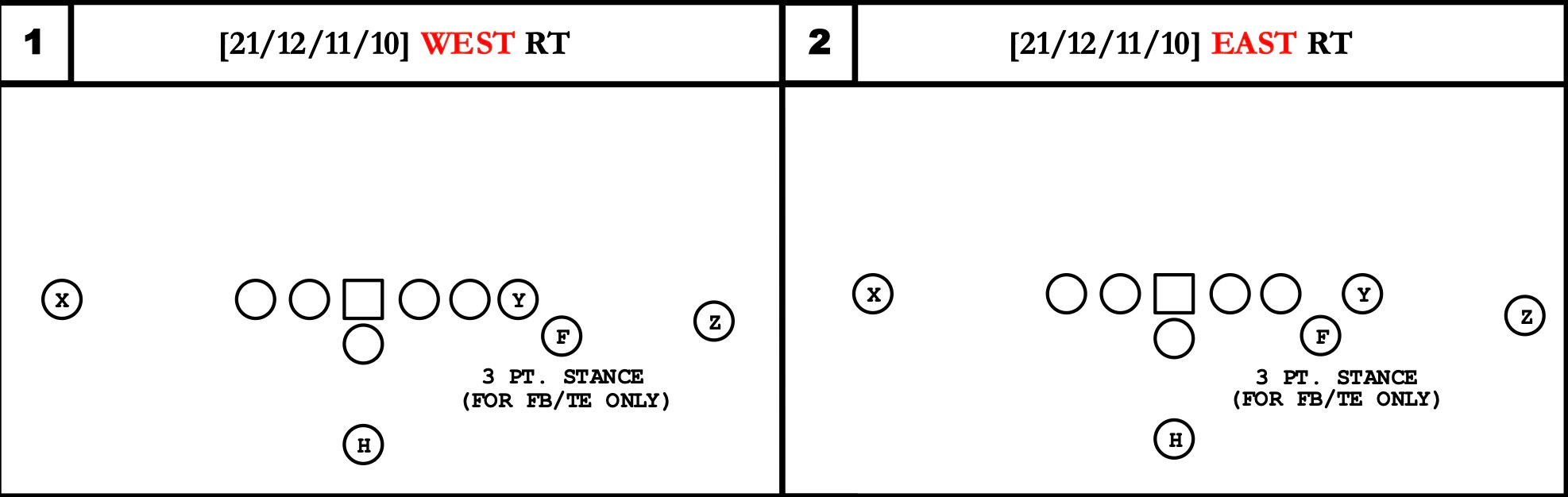
There are two formations in this picture, West Right and East Right. These are paired together. You’ll notice the F lines up on the same side as the Y tight end, but in different spots in each formation. In old Mike Shanahan playbooks, you’ll see the phrase “It’s warm in the west, so go outside” and “It’s cold in the east, so go inside”. This is information for the Y and the F. In West Right, the F lines up outside of the Y tight end because it’s “warm in the west, go outside”. In East Right, the F lines up inside the Y tight end because it’s “cold in the east, go inside”.
There’s millions of funny little terms and quirks like that in these playbooks. Terms might seem like complete nonsense but they typically have a reason for them like that which helps players remember certain aspects of a formation.
So now we have our base formation. West Right tells the Y tight end to line up to the right of the formation and the F tight end to line up just outside of him. But if you go back and watch the video of the original play, you’ll notice there’s no receiver outside to the right and in fact both receivers are aligned to the left. This is where a formation adjustment term comes in. We are still in West Right, but we also need to add the term “Slot” to tell the Z receiver to line up in the slot away from the Y TE, instead of outside on the same side as the Y TE.
That gives us our initial formation for the play - West Right Slot. In a playbook, it looks like this:
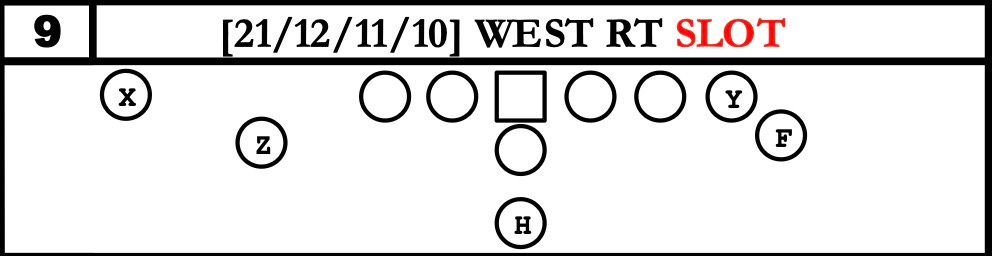
That formation is the exact one we see from the video. Both tight ends line up to the right with the F tight end outside of the Y tight end, while both receivers align to the left side of the formation, away from the tight ends.
With the formation sorted, the next thing in our order of operations is motions. In the video, you’ll see that prior to the snap, Kaliakmanis sends the F tight end in motion across the formation from right to left. This is simply known as “F Left”. We add that tag to the formation and we get West Right Slot F Left.
After sorting out the formation and motion, we can finally get to the actual concept of the play. The Commanders run a wide zone run scheme to their left, away from the Y tight end. West coast offenses use a number to tell you what type of run and which direction it’s going. These numbers can vary from system to system, so there’s every chance David Blough has his own number here for a wide zone run. But in the Shanahan system, wide zone runs are known as 18 or 19, while inside zone runs are known as 14 or 15. These numbers appear random but they have reasoning to them. The first digit of the number typically tells you what type of run, while the second digit tells you the direction and often aiming point.
The Shanahan system is built around the zone run scheme, so they use numbers between 10-19 to indicate a base zone run. They don’t use many power run schemes, so they will leave those in the 90-99 series of numbers, but other teams can change those around. So now we know a zone run will begin with a 1, but what about the second digit? It’s pretty universal that teams will use even numbers to indicate a run to the right, while they’ll use odd numbers to indicate a run to the left. Most teams will also use higher numbers in the series to indicate runs to the outside gaps, while lower numbers are more inside runs.
So if we apply that knowledge to our run call, we know it’s a wide zone run to the outside. That means the number will start with a 1 to indicate the zone scheme. It’s an outside zone rather than an inside zone, so the second digit will be higher, either 8 or 9. We also know it’s a run to the left and that teams use odd numbers to indicate runs to the left. So with all of that put together, we know this run is called 19. We can add that to our playcall now, which gives us West Right Slot F Left 19.
After that, we need any additional run concept information or the passing concept. This isn’t a pass play so we’re focused on the additional run information. These are typically tags that make adjustments to the base scheme. In our case, there’s two adjustment tags we need to add. The first is a tag to signify we’re running to the weak side of the line. The strength of the line is typically defined by the Y tight end. So in West Right, the Y tight end is to the right, so that is the strong side of the play. When you run away from the tight end, it’s known as running to the “weak” side. Teams will add a tag to indicate this in the scheme. It will typically be a name or word beginning with W to indicate a weak run. In the Shanahan system, they use the term “Wanda”.
That tag nearly gives us our full playcall. West Right Slot F Left 19 Wanda is almost there. But there’s one final part of the play we need to tag. As Kaliakmanis snaps the ball, you’ll notice the F tight end that went in motion prior to the snap suddenly appears in the picture. While the whole offensive line blocks to the left side on a zone run, the F tight end works back across the line to the right side. This is commonly known as a sift or slice. The Shanahan system calls it a sift, so we’ll use the tag “F Sift” to let that F tight end know we want him to sift back across the line and cut block the edge defender on the back side of the run.
That tag seems like a small detail but it’s really important. Those sift blocks can create big holes in the defense as linebackers or safeties follow the sifting tight end and get out of position. The tight end cutting the back side edge defender can also open up a nice cut back lane for the running back if he cuts inside. But most importantly, it also sets up a threat of play-action. The natural complement to a wide zone run scheme is a play-action bootleg. On a bootleg scheme, those tight ends running the sift blocks will fake the sift block and sneak out to the flat as a primary option for the quarterback to dump the ball off and pick up a nice chunk of yards after the catch.
With that final tag, we finally have the construction of our playcall. West Right Slot F Left 19 Wanda F Sift. That might appear like a wordy and complex playcall, but that’s actually relatively basic for a typical west coast offense. There’s a reason the Commanders were using that play on their first day of rookie mini camp, because it is quite simple once it’s boiled down to the basics.
If you want to add more layers, typically a coach like Kyle Shanahan would call a second play in the huddle that the team can get to if they get a bad look. That could be an alternate run if the defense gives a front that is strong against wide zone runs, or it could be the play-action bootleg that works with the run play. Then the play would become something like “West Right Slot F Left 19 Wanda F Sift Can With Fake 19 Wanda F Slice”. That then tells the quarterback he has the ability to “can” (like a trash can, meaning throw away) or “kill” the first play and get to the second play at the line of scrimmage if the defense gives them a particular look. The second play in this call would be “Fake 19 Wanda F Slice” which is the play-action bootleg variation I mentioned earlier.
Clearly there’s a lot going on with these wordy play calls but when you boil them down to their ingredients and play call structure, they make sense. It is like learning a new language though, so it’s easy to see why Kaliakmanis had some trouble getting that play called and run correctly in the huddle during his first rookie camp practice. You might feel like teams should be able to cut down the words and play faster, and they do. Most teams have an up-tempo/no-huddle part of the playbook where they have a group of plays that are given a single word for the whole play. But by having this structure and language, it allows the team to be a lot more flexible and versatile with the personnel groupings, formations, motions and plays they get to throughout a game.
Man, and I thought physics was tough!
This what I love about this stack. I learned a lot of this years ago but things are constantly changing in the NFL. These days I hear things that don't jive with what I originally learned, particularly around the slot and tight end. This article clears up some of the things that have confused me lately.